Below that level the house tends to draw air in.
Radon basement levels first floor difference.
How to test your home for radon it s.
It was done when the weather was cold enough to be sure all windows were likely to be closed.
Above it the tendency is to exhale.
Not that that is a bad thing but most people do not live in the basement.
The us epa was tasked with setting practical guidelines and recommendations for the nation.
Each measurement was in the same horizontal place near the center of the building.
The 2nd floor was 6 7 and the 3rd was 9 2.
The radon levels on all three floors were measured simultaneously.
There is a natural level of radon in the ambient air estimated at about 0 4 pc l but what we are more concerned about is concentrated levels of radon indoors.
3 to 5 pci l on the first floor and 11 to 13 pci l in the upstairs bedrooms.
If your furnace or duct runs are located in your basement or crawlspace anytime the furnace fan runs for either heat or air conditioning the radon level on the first floor is often the same as it is in the basement or crawlspace.
About one in every 15 homes is thought to have high levels of radon.
I have seen similar results in other homes including my own 1820 s farmhouse which had radon level of 17 pci l in the unfinished stone wall and dirt floor basement.
Here s a question i get a lot do we need a radon system installed in our basement.
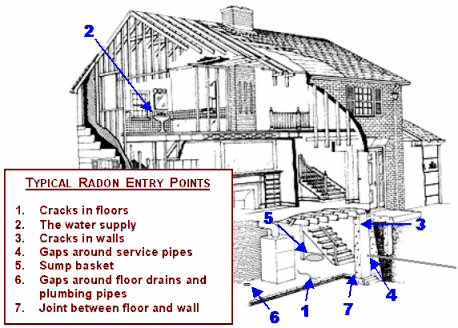
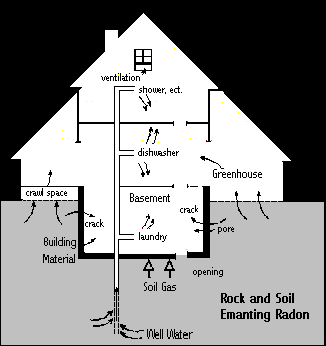
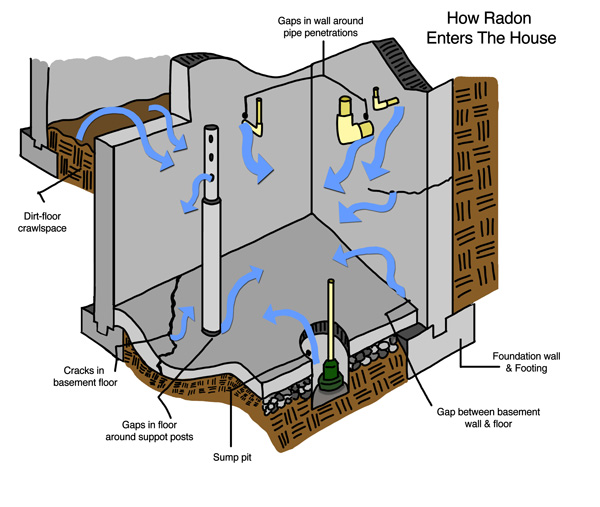
Radon enters buildings through cracks in the foundations and or basement walls unsealed joints and utility chases.
Staying out of the basement doesn t matter if your furnace fan is running even occasionally.
And if they do they normally have ventilation thereby bringing down the risk of radon exposure immensely.
The unfinished basement radon level was slightly above 4 pci l the first floor was lower at just above 2 pci l and one of the second floor bedrooms tested at above 8 pci l.
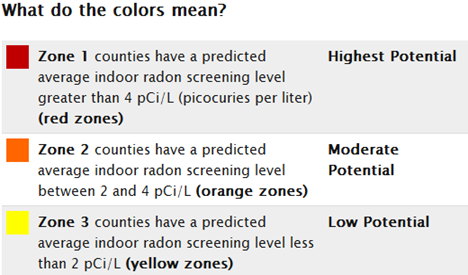
Unfortunately two thirds of all homes exceed this level.
In that case radon remediation is forced on you.
How does it get in.
By the way if you let a skunk loose in your basement you d smell it.
The only real worry is if the levels of gas are really high and you inhabit the basement.
Surprisingly we find that the second floor typically has more radon than the first.
This is because the neutral pressure plane is typically about halfway up the wall on the top floor.
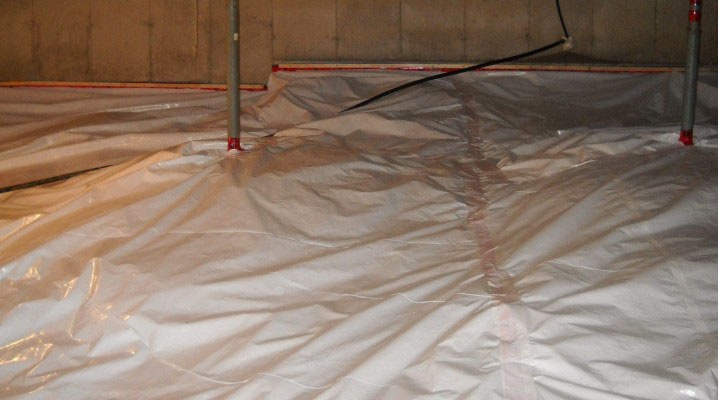
Caulking basement floor cracks coating basement walls or floors with waterproofing compounds sealing the tops of open drains installing caps on sump pump holes and covering bare crawlspace floors with plastic are a few techniques that can dramatically lower radon levels.
To this end the us epa has set an action level of 4 pci l.
The first floor was 7 3 pci l.
The highest concentration of radon tends to be found in the basement or on the first floor.